
Introduction: Beyond the Numbers
Sentiment analysis is a technique used in trading that involves using emotional and social data to predict market movements. While technical analysis focuses on the *what* (price and volume) and fundamental analysis on the *why* (intrinsic value), sentiment analysis focuses on the who (the attitude and mood of the participants).
Traditionally focused on general market psychology, this analysis has drastically evolved to include the use of *Big Data*, natural language processing (NLP), and artificial intelligence to analyze sentiment in social networks, forums, and other data sources in real-time.
What Exactly is Sentiment Analysis?
In the context of trading, it is the process of quantifying the "sentiment" or emotions of investors regarding a particular asset (stocks, currencies, cryptocurrencies). This sentiment can be categorized as positive (bullish), negative (bearish), or neutral. The premise is that collective sentiment can be an indicator of future trends, often serving as a contrarian indicator or confirmation.
The Contrarian Principle:
Extremely bullish sentiment (greed) often precedes a market top, while extremely bearish sentiment (panic) often precedes a market bottom. Sentiment serves as an indicator of emotional saturation in one direction.
The Impact of Social Media and Big Data
Social networks have drastically changed how sentiment analysis is performed, moving from slow surveys to real-time analysis of large volumes of text. With millions of people expressing their opinions on different financial assets in real-time (Twitter, Reddit, Discord), these platforms are now a goldmine of data:
- Volatility and Virality: Social networks can catalyze rapid market movements, as seen in the "meme stock" phenomenon. Analysis must be able to filter out noise and detect genuine trends.
- Text-Based Indicators: News, blogs, and financial publications are analyzed. A high volume of positive articles about a stock can confirm a bullish trend, while a sharp change could warn of a shift in direction.
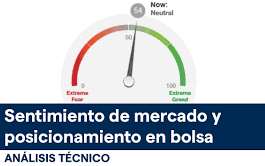
- Non-Social Sources: Other data are also monitored, such as COT reports (Commitment of Traders), option Put/Call ratios, and investor surveys (AAII, Fear & Greed Index).
Artificial Intelligence Applications in Analysis
Artificial intelligence (AI) and Machine Learning are indispensable for processing the volume of current sentiment data. Specialized algorithms are used to:
- Advanced NLP: Natural Language Processing models can read and "understand" texts, identifying not only keywords (*buy*, *sell*) but also the emotional context (sarcasm, frustration, euphoria).
- Data-Driven Prediction: Algorithms can be trained to correlate changes in social media sentiment with subsequent price movements.
- Noise Filtering: AI is essential for filtering out *spam* and irrelevant information, concentrating on the voices of greater influence or credibility.
How is Sentiment Used in Trading Strategies?
Sentiment analysis should never be the sole basis for a decision, but a piece of the puzzle:
- Complement to Technical Analysis: If the price is near a key support level and sentiment is at extreme panic levels (oversold), this could be a strong reversal buy signal.
- Trend Confirmation: A strong price movement supported by consistently positive social sentiment indicates that the movement has solid psychological fundamentals.
- Contrarian Indicator: When everyone agrees and sentiment metrics reach maximum greed, a professional trader might consider taking profits or opening a short position.
Challenges and Limitations of Sentiment Analysis
Although powerful, this analysis carries risks and difficulties:
- Inaccurate Measurement: Sentiment can be difficult to measure accurately; algorithms may confuse mockery or sarcasm with genuine sentiment.
- Data Volatility: Social media sentiment data can change drastically in seconds, making trading signals highly volatile or quickly canceled.
- Manipulation Filters: Markets can be susceptible to sentiment manipulation (*pump and dump*) through coordinated social media campaigns.
As with any technology, AI has its limitations and must be used with caution and a solid understanding of risk analysis.
Conclusion: Who Should Use Sentiment Analysis?
Sentiment analysis can be used by a wide range of traders, from beginners looking to understand market psychology, to fund managers integrating Big Data into their algorithmic models. However, it is crucial to remember that it is only one tool.
The successful trader uses it to gain a marginal advantage and to verify conditions of emotional saturation before executing a trade, never as the sole basis for decision. A solid, diversified trading plan that takes into account a variety of factors (technical, fundamental, and psychological) is always essential.
📚 Recommended Readings
- "Trading in the Zone" by Mark Douglas: The foundational reading on individual trading psychology and how attitude affects performance.
- "Extraordinary Popular Delusions and the Madness of Crowds" by Charles Mackay: A classic illustrating how collective emotions (manias and panics) have driven historical bubbles and collapses.
- Any Research Paper on NLP in Finance: For a technical view, look for academic articles on how natural language processing is used to predict the impact of news headlines on stock prices.